

Publications
SIERC's CEO and associates have produced an impressive list of publications - from books, articles and reviews to published speeches on a range of subjects. Here are a few published and forthcoming publications.

The Swedish deal, the defence bank and the West’s awakening from its long dream
Dr. Laurence B. Mussio, SIERC, and Dr. Jessica M. Lomas, King's College London
Published in The Globe and Mail, May 29, 2026
Canada is moving away from heavy dependence on the United States by rebuilding domestic defence production and helping create a new multinational “defence bank” meant to fund long term military capacity across democratic allies. Writing in The Globe and Mail, Dr. Laurence B. Mussio and Dr. Jessica M. Lomas analyze this shift in Canadian defence strategy. They look at what it is, why it’s needed and Canada’s role, examining the historical echoes and the challenges ahead.

A modest idea for the institutions that run our economy
Dr. Laurence B. Mussio, CEO, SIERC & Chair, Long Run institute
Published in The Globe and Mail, May 2, 2026
In this op-ed, Laurence Mussio reflects on the life of his father, an Italian immigrant who worked as a boilermaker and believed deeply in the postwar promise of Canada: that hard work would build lasting institutions and a better future for later generations. The author argues that this intergenerational bargain has broken down. Canada, he says, is now losing capital, talent, and competitiveness, while its institutions have become slow, indecisive, and unable to execute. He draws historical parallels, suggesting the country still has the tools to renew itself if institutions and leaders choose to act decisively.

Turning Historical Experience into Judgment.
Dr. Laurence B. Mussio, SIEC, LRI & Dr. Cosimo Pacciani, Poste Italiane
Published in The Globe and Mail, 4 April, 2026
In the fourth and final installment of the Futures @ Risk series published in The Globe and Mail, Dr. Laurence B. Mussio and Dr. Cosimo Pacciani use two parallel maritime catastrophes, one in 1816 and one in 2012, to argue that many great disasters are caused not by unknown risks, but by known dangers that institutions choose to ignore. Citing other examples where warnings were recorded, filed, and forgotten, the authors note that institutions excel at producing data and reports but fail at converting experience into action. The authors define this missing capability as “Mnemonic Capital”—an institution’s living capacity to turn historical experience into present judgment—and examine ways this can be achieved.

The Ghost in the Machine is outpacing the real world.
Dr. Laurence B. Mussio, SIEC, LRI & Dr. Cosimo Pacciani, Poste Italiane
Published in The Globe and Mail, 6 February, 2026
In this third “Futures @ Risk” essay, Dr. Laurence B. Mussio and Dr. Cosimo Pacciani use art and history to argue that modern society is governed by “Ghost Intelligence”: fast, automated digital systems that operate without the institutional memory needed to understand their physical foundations. While economies have optimized for algorithms, finance, and cloud computing, they have neglected the “Body” of civilization—energy grids, supply chains, materials, and infrastructure—leaving systems vulnerable to adversarial risks in what thinkers describe as a new era where risk is deliberately weaponized. The authors discuss the broader lessons and implications.

Canada has become a place to be from – and opera can teach us a lesson
Dr. Laurence B. Mussio, CEO, SIERC & Chair, Long Run institute
Published in The Globe and Mail, 24 January, 2026
Writing in The Globe and Mail, Dr. Laurence B. Mussio recalls a childhood memory of seeing La Traviata in Sarnia and observes how opera can reveal deeper truths about society. While preparing to attend the Canadian Opera Company’s performance of Rigoletto in Toronto, Dr. Mussio notes that Rigoletto actually offers a powerful metaphor for Canada’s current economic and cultural condition.

Why we forget lessons learned from collapsed bridges, burned towns and financial crises
Dr. Laurence B. Mussio, SIEC, LRI & Dr. Cosimo Pacciani, Poste Italiane
Published in The Globe and Mail, 1 January, 2026
In their second “Futures @ Risk” essay in The Globe and Mail, Dr. Laurence B. Mussio and Dr. Cosimo Pacciani note the existence of a “strategic amnesia” which allows institutions to document dangers without acting on them. They argue that while disasters often show a recurring pattern, knowledge becomes fragmented across bureaucratic silos, no one is responsible for synthesizing warnings into action, and economic incentives reward continuing operations rather than pausing to address risk. The authors propose various mechanisms to help avoid preventable catastrophes.

Can ambition triumph over stagnation in Carney’s Ottawa?
Dr. Laurence B. Mussio, CEO, SIERC & Chair, Long Run institute
Published in The Globe and Mail, 15 December, 2025
Dr. Laurence B. Mussio writes in The Globe and Mail that Prime Minister Mark Carney faces a fundamental challenge: translating long-term economic vision into real projects within a federal system known for slow execution. Government machinery is structurally resistant to rapid change, and political actors are more skilled at short-term tactics than delivering complex projects. The author argues, however, that Canada has a deeper problem, a lack of institutional memory and execution capacity—what the author calls a deficit in “mnemonic capital.”

The transformation of risk in the Ozempic era
Dr. Laurence B. Mussio, CEO, SIERC & Chair, Long Run institute
Published in The Globe and Mail, 26 November 2025
In this opinion piece, Dr. Mussio argues that Novo Nordisk’s sudden loss in market value following its Ozempic profit warning illustrates a new form of corporate risk: the moment when a successful product becomes social infrastructure. He contends that managing infrastructure-level risk requires historical awareness, proactive engagement with governments, and acceptance of public obligations before regulation is imposed. He asserts that breakthrough innovation does not remove risk; it transforms it — and failure to recognize that transformation can be more destructive than any technical or market misstep.

History teaches us how to manage risk
Dr. Laurence B. Mussio & Dr. Cosimo Pacciani, Poste Italiane
Published in The Globe and Mail, 20 November 2025
In this first essay in the Globe’s Futures @ Risk series, Dr. Mussio and Dr. Pacciani argue that effective risk management requires integrating historical consciousness with modern analytical tools. Exploring historical and modern examples, the authors show how overreliance on narrow, short-term models and “leader-centric” decision-making leaves systems vulnerable to rare but devastating shocks. They suggest that organizations that deliberately preserve, teach, and apply historical lessons—pairing computational power with long-term perspective—are best positioned to navigate instability and avoid failure in the face of catastrophe.

Canada’s money lives in exile. We’re rich abroad, but starved at home
Dr. Laurence B. Mussio, CEO, SIERC & Chair, Long Run institute
Published in The Globe and Mail, 25 October 2025
In this article, Dr. Mussio argues that Carney’s surprise victory at the polls preserved the influence of Canada’s Laurentian elite. However, as this elite now presides over an economy facing stagnation, a housing crisis, innovation decline, and flawed energy policy, Carney must act quickly: the election win is not a mandate but a narrow window to enact real change – such as a national productivity commission, fiscal reform, productivity-focused immigration policy, and intergenerational policy assessments – before disillusionment empowers a new opposition.

At the G7, Canada’s globalist ambitions put our domestic problems in stark contrast
Dr. Laurence B. Mussio, CEO, SIERC & Chair, Long Run Institute
Published in The Globe and Mail, 17 June 2025
In this article, Dr. Mussio argues that Carney’s surprise victory at the polls preserved the influence of Canada’s Laurentian elite. However, as this elite now presides over an economy facing stagnation, a housing crisis, innovation decline, and flawed energy policy, Carney must act quickly: the election win is not a mandate but a narrow window to enact real change – such as a national productivity commission, fiscal reform, productivity-focused immigration policy, and intergenerational policy assessments – before disillusionment empowers a new opposition.

For Carney to succeed, he must convince Canada’s elite that it’s time for change
Dr. Laurence B. Mussio, CEO, SIERC & Chair, Long Run institute
Published in The Globe and Mail, 16 May 2025
In this article, Dr. Mussio argues that Carney’s surprise victory at the polls preserved the influence of Canada’s Laurentian elite. However, as this elite now presides over an economy facing stagnation, a housing crisis, innovation decline, and flawed energy policy, Carney must act quickly: the election win is not a mandate but a narrow window to enact real change – such as a national productivity commission, fiscal reform, productivity-focused immigration policy, and intergenerational policy assessments – before disillusionment empowers a new opposition.

New Report: “Applying History to Inform Anticipatory AI Governance”
Dr. Laurence B. Mussio, CEO, SIERC; Chair, Long Run Institute & RAND Corporation
Published by RAND Corporation, 2 April 2025
SIERC is pleased to share an important new report from RAND Corporation and Dr. Mussio in his role as Chair of the Long Run Institute: “Applying History to Inform Anticipatory AI Governance: Using Foresight and Hindsight to Inform Policymaking.” This publication represents the culmination of a two-year collaboration between RAND and the LRI, bringing together Nobel Prize Winner Dr. Robert J. Lempert and Dr. Jonathan W. Welburn with Professor Michael Aldous and Dr. Laurence B. Mussio to explore how historical analysis can inform AI governance frameworks. The full report is available on the RAND website.
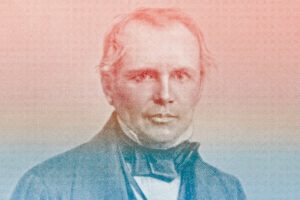
A new nationalism is emerging in Canada
Dr. Laurence B. Mussio, CEO, SIERC & Chair, Long Run Institute
Published in The Globe and Mail, 29 March 2025
In this op-ed, Dr. Mussio examines historical and contemporary expressions of Canadian nationalism in response to external threats, drawing parallels between the 19th and 21st centuries. With specific examples he argues that Canada’s historical resilience in the face of existential threats suggests a capacity for unity and sacrifice, even in a modern context where economic dependency on the U.S. poses challenges to independence.

Decoding Trump’s trade strategy: The historical pattern beneath the headlines
Dr. Laurence B. Mussio & Dr. Marvin Suessse, Trinity College Dublin
Published in The Globe and Mail, 14 March 2025
In this article Dr. Mussio and Dr. Suesse analyze the underlying logic of Donald Trump’s trade policies through three competing interpretations: a Bluff Thesis, a Reckless Driver Theory and as a Geopolitical Realignment Strategy. However, they also suggest that Trump’s policies are less about foreign threats and more about punishing “globalist” elites within the U.S., echoing other historical patterns. Ultimately, economic nationalism isn’t an anomaly but a recurring force, and businesses and policymakers must recognize and adapt to these cycles.

Today’s North American Economic Nationalism isn’t unprecedented it’s a pattern
Dr. Laurence B. Mussio and Dr. Mavin Suesse, Trinity College Dublin
Published in The Globe and Mail, 21 February 2025
In this piece, Dr. Mussio and Dr. Suesse argue that the current rise of economic nationalism in North America, exemplified by U.S. tariffs and trade tensions, is not unprecedented but part of a recurring historical pattern. Since 1840, North America has experienced at least five major cycles of economic nationalism, often triggered by a combination of domestic political shifts, technological disruption, and geopolitical tensions. Today, the key difference is the deep economic integration between Canada and the U.S., making the stakes that much higher. However, it is clear that history also offers hope.
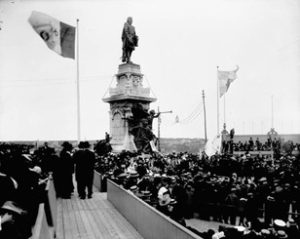
How Canada must face its winter of reckoning
Dr. Laurence B. Mussio, SIERC CEO & Long Run Institute Chair
Published in The Globe and Mail, 17 February 2025
In this op-ed, Dr. Mussio explores Canada’s current economic and institutional crises, arguing that history provides lessons for renewal. He highlights how Canada has long struggled to balance aspirations with practical governance and emphasizes the need for courage, competence, and cultural renewal. The unbuilt "Angel of Peace" monument serves as a metaphor for Canada's unrealized potential, urging leaders to embrace bold reforms and rekindle a shared sense of purpose.
Image Credit: Library and Archives Canada

DeepSeek and the trillion-dollar history lesson
Dr. Laurence B. Mussio & Professor, John Turner, Queen’s University Belfast
Published in The Globe and Mail, 6 February 2025
In this article Professor Turner and Dr. Mussio discuss the recurring boom-bust cycle in technology and markets, using the recent DeepSeek AI breakthrough as an example. The article highlights how decision-makers often overlook early warning signs – but understanding historical cycles can help businesses better navigate future technological shifts.

Podcast: Boom, Bust and the Echo of History
What can history teach us about today’s financial landscape? In the latest episode of the popular BMO Capital Markets podcast, SIERC CEO and LRI Chair Dr. Laurence B. Mussio interviews Professor John Turner, co-author of the award-winning Boom and Bust: A Global History of Financial Bubbles. Together they discuss:
- The echoes of past booms and busts in today’s markets
- The transformative potential of AI and general-purpose technologies
- The impact of globalized finance on shaping future economic cycles

Dr. Laurence B. Mussio elected Fellow of the Royal Historical Society
It is with great delight that SIERC announces the election of SIERC CEO Dr. Laurence B. Mussio to the UK’s prestigious Royal Historical Society. Founded in 1868, “the Royal Historical Society promotes and defends the scholarly study of the past and speaks for the interests of history and historians for the wider benefit of all,” notes Dr. Judy Stephenson of University College London where the Society is based, and who is also a Fellow of the RHS.

Doom Scrolling, Big Tech and Public Policy: The Long View
Dr. Laurence B. Mussio & Dr. Dimitry Anastakis, Wilson/Currie Chair in Canadian Business History, Rotman School of Management, University of Toronto
Published in The Globe and Mail, 28 September 2020
“Anybody that “doom scrolls” Twitter or any other social media platform might be tempted to believe that Winston Smith, the tortured protagonist of Nineteen Eighty-Four, might see in our own moment strong parallels to his own archetypal dystopia.” Yet The article notes we have the power - the human agency - to change things.
How Economics Tested Positive for COVID-19
Dr. Laurence B. Mussio, & Douglas J. Porter, CFA, Chief Economist and Managing Director, BMO Financial Group
Published in The Globe and Mail, 23 September 2020
“The pandemic experience points us toward an approach that embraces a greater interdisciplinary perspective – one that current models were not designed to provide.”
How the Pandemic is Changing Views on Financial Risk
Dr. Laurence B. Mussio
Published in The Globe and Mail, 13 September 2020
“In finance, the pandemic has demonstrated the value of, and the need for, human judgment in an increasingly algorithm-driven sector.”

Whom Fortune Favours: The Bank of Montreal and the Rise of North American Finance.
Volume 1: A Dominion of Capital, 1817-1945.
Volume 2: Territories of Transformation, 1946-2017.
Laurence B. Mussio
McGill-Queen’s University Press, April 2020
This second title in the Bank of Montreal historical series provides the definitive, scholarly history of one of the North Atlantic world's oldest and most consequential financial institutions.
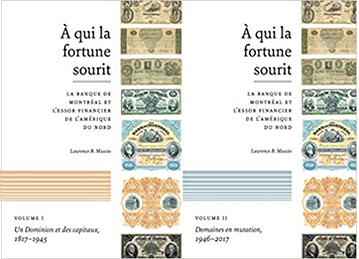
À qui la fortune sourit: La banque de Montréal et l'essor financier de L'Amérique du Nord, Volume 1 & 2.
Volume 1: Un Dominion et des capitaux, 1817-1945
Volume 2: Domaines en mutation, 1946-2017
Laurence B. Mussio
McGill-Queen’s University Press, April 2020

Why executives need the long-run view
Laurence B. Mussio
Published in The Globe and Mail, 27 December 2019

Big Tech: Monopoly’s Second Moment?
The Hon. Dr. Kevin G. Lynch, P.C., O.C., PH.D, LL.D, and
Dr. Laurence B. Mussio
Published in Policy: Canadian Politics and Public Policy, 13 May 2019
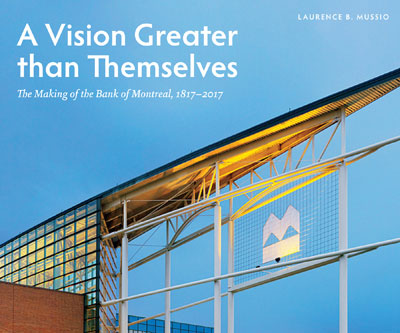
A Vision Greater than Themselves: The Making of the Bank of Montreal, 1817-2017
Laurence B. Mussio
“Examining an astonishing range of material, A Vision Greater than Themselves celebrates the evolution of one bank and how it made its mark.”

Un destin plus grand que soi: L’histoire de la Banque de Montréal de 1817 à 2017
Laurence B. Mussio
“À partir d’une gamme incroyablement vaste de documents, Un destin plus grand que soi célèbre l’évolution d’une banque et la manière dont elle a laissé sa marque.”
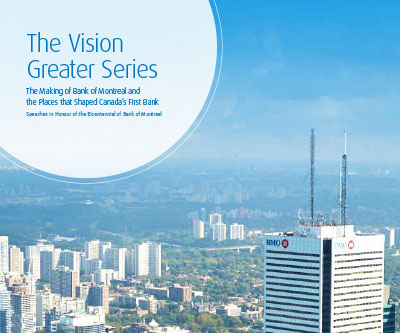
The Vision Greater Series: The Making of the Bank of Montreal and the Places that Shaped Canada's First Bank. Speeches in Honour of the Bicentennial of Bank of Montreal
Laurence B. Mussio
This publication reproduces some of the keynote addresses Dr. Mussio made across the North Atlantic world to mark the bicentennial of BMO Bank of Montreal. It was made available internally to the Bank’s 46,000 employees December 2017. A limited number of special edition hard copies were also produced to accompany the publication.
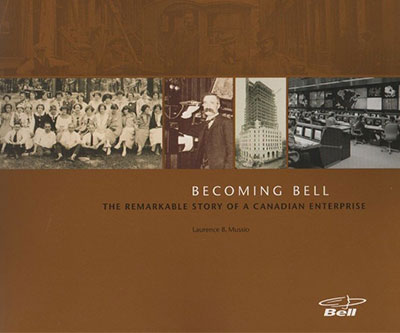
Becoming Bell: The Remarkable Story of a Canadian Enterprise
Laurence B. Mussio
Published by BCE
“Written to be accessible and engaging while telling an important story, this history of Bell reached over 75,000 people and was widely praised as a model of its genre.”
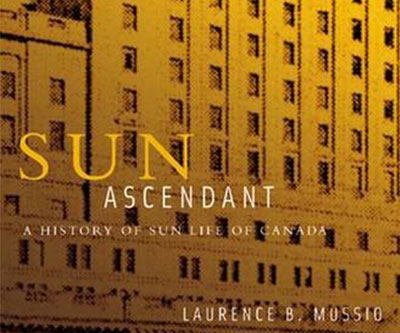
Sun Ascendant: A History of Sun Life of Canada
Laurence B. Mussio
McGill-Queen’s University Press, 2001
“Profoundly well researched ... the best history of a Canadian financial institution written to date. Sun Ascendant is a major contribution to business history, both in this country and internationally” - Professor Ben Forster
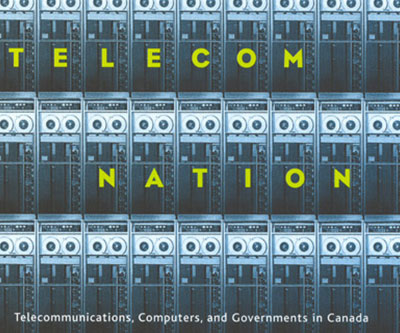
Telecom Nation: Telecommunications, Computers, and Governments in Canada
Laurence B. Mussio
McGill-Queen’s University Press, 2001
“Telecom Nation makes an important contribution to telecommunications history in Canada” - Jean-Guy Rens